Data / Analytics
Case 03 / 14
A Slack AI analyst the whole company asks
A Slack agent that answers ops data questions in plain English, built on written definitions of our business terms, and shows the source and SQL behind every number.
Crave Robotics · 2026 · Sole designer and builder
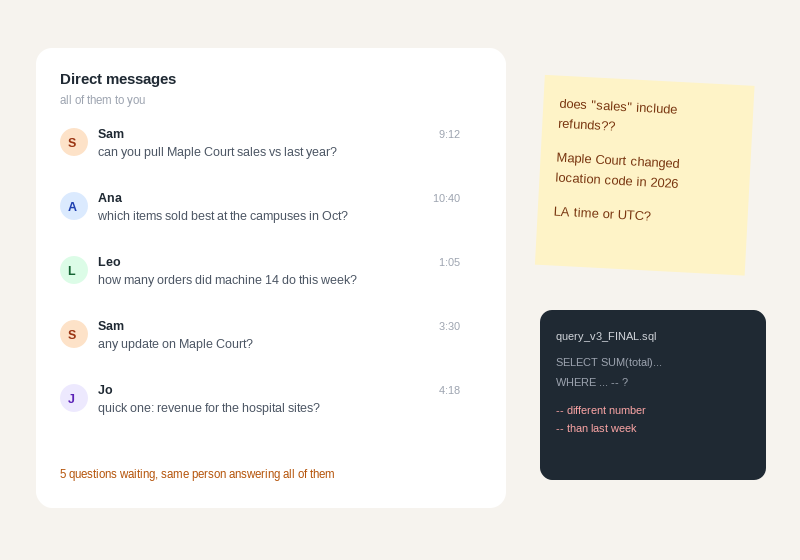
- The CEO and 4 teams (hardware, marketing, partnerships, field technicians) asked ops data questions every day, and each one waited on me: 15–20 minutes of work, but hours of waiting when I was busy.
- Now they ask a Slack agent: 200+ questions in 2 months, answered in minutes, 50+ hours of analyst time back.
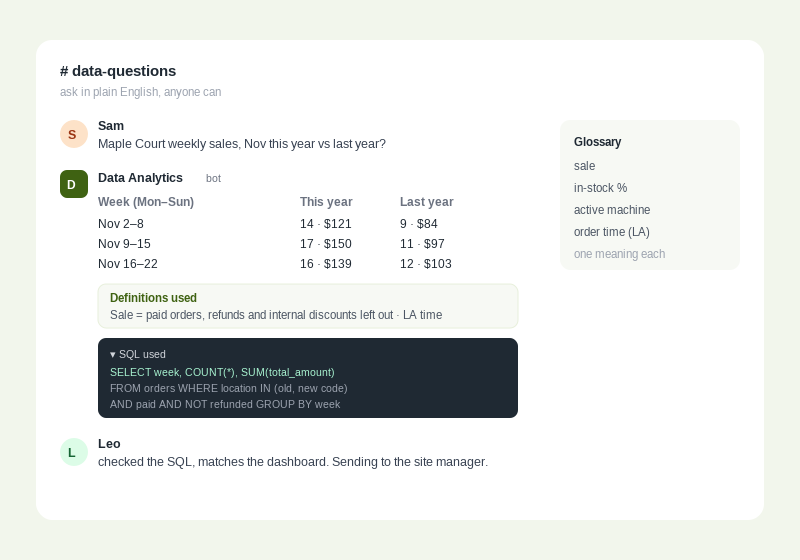
- It works from written definitions (what counts as a sale, in-stock %, an active machine) and tags every number with its source and SQL, so anyone can check it.
- Its top-seller answers shaped our campus menus, and the products it surfaced are now top-3 sellers at 6 locations.
Before and after
Illustrations, drawn for this page.
The numbers
- Minutesfrom HoursTime to an answer
- 200+ in 2 monthsQuestions answered
- 50+ hoursAnalyst time saved
- Top-3 sellers at 6 locationsCampus-menu picks it surfaced
- LLM text-to-SQL
- PostgreSQL data warehouse
- Uptime API
- Slack API
How it fits together
- 1Question in Slack
- 2Match words to defined terms
- 3Write SQL on a warehouse copy
- 4Add uptime and Slack context
- 5Answer with sources + SQL
- 6A person checks and shares
Read the full case study Hide the case study
The problem
Once the company had one operating platform, people started asking questions it had no page for: sales at one site this year versus last, the best sellers on a campus, why a machine went quiet. Those questions came to me from the CEO, hardware, marketing, partnerships and the field technicians. Each took 15–20 minutes to answer, but when I was busy, people waited hours.
Each answer was a fresh SQL query, and the same word could quietly mean two numbers. Does “sales” include refunds? Is a day in LA time or UTC? Two honest queries could disagree.
What I built
A Slack agent anyone can ask in plain English. Before it writes any SQL, it looks up the business terms in the question in a written glossary: what a sale is (paid orders only, refunds and internal discounts left out), what in-stock % means, what counts as an active machine, and which time zone a date is in. It writes the query from those definitions and runs it on a separate copy of the data in a warehouse, never on the live system.
The first version answered from order data alone. The current one also reads machine uptime, a searchable archive of Slack messages and a log of site events, so it can explain a number, not just report it. Every figure is tagged with where it came from, guesses are labelled as guesses, and when the data cannot answer a question, it says so instead of approximating.
This is the same idea as an ontology or semantic layer: a shared map from the words people use to the data and formulas behind them, so every answer computes a metric the same way.
Answers that changed decisions
When we rebuilt the menus for our university campuses, the top-seller answers came from the agent, with duplicate product names merged so the ranking was right. Those products are now top-3 sellers at 6 locations.
An answer that changed the question
A hospital site showed eleven straight days of zero sales, which looked like demand falling off. The agent pulled uptime and order history and showed something else: the machine had been locked, then swapped for a new one, and weekly sales had been climbing right up to the day it stopped. It also caught that the new machine sells under a new location ID, so every later query for that site has to include both.
Why the source is in every answer
People trust a number they can check. With the source and SQL attached, whoever asked, or anyone else in the thread, can see exactly what was counted before the number goes to a site partner or into a deck.
What I learned
Writing SQL was never the hard part. Agreeing on what a word means was. Once "sale" and "in-stock %" had one written definition each, answers stopped disagreeing with each other, and showing the source and SQL turned "is this number right?" into something anyone could check in a minute.
What I would do next
Fold the corrections people make in Slack back into the glossary, so the shared definitions get better with every question instead of living in one person's head.
Described without confidential information. The demo and any figures inside it use synthetic data.